Eccentric cone in metal fabrication: difference between concentric and eccentric reducers
Understand the difference between concentric and eccentric cones, where each type of reducer is used, and why this choice completely changes the part's layout.
In industrial metal fabrication, not all cones are the same.
Two pieces may look similar at first glance but have completely different functions, layouts, and applications. This is the case with concentric reducers and eccentric reducers, also known in practice as concentric cones and eccentric cones.
The main difference lies in the alignment of the centers.
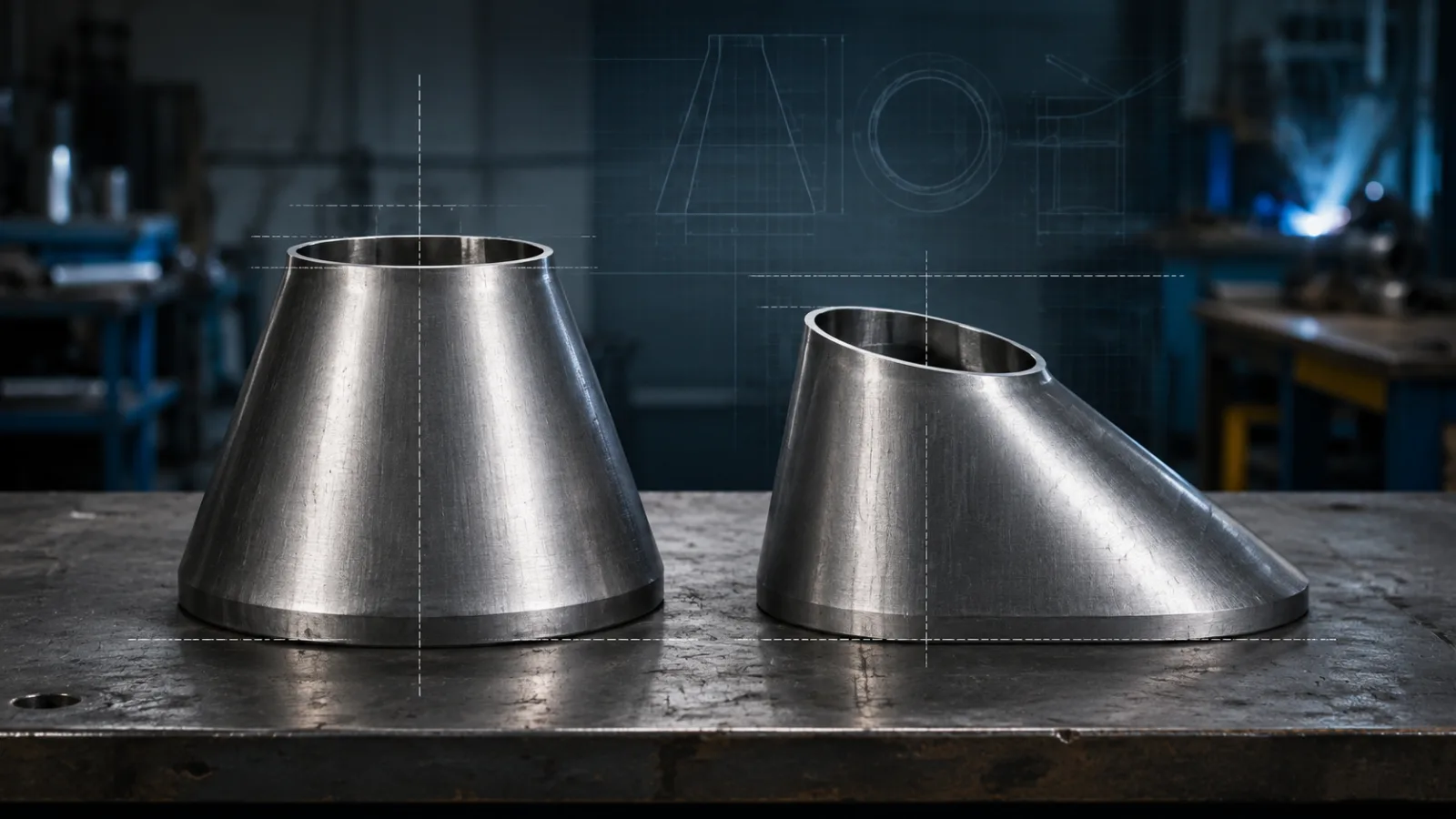
In a concentric reducer, the larger diameter and the smaller diameter are aligned along the same central axis. In an eccentric reducer, these centers are offset, creating a piece with one side more “straight” or level and the other side inclined.
This difference changes everything: the shape of the piece, the flat pattern development, the fit, the application, and even the care required during assembly.
What is a reducer in metal fabrication?
A reducer is a component used to transition between two different diameters.
It can be found in piping, ducts, industrial systems, equipment, exhaust systems, material transport, metal structures, and various types of plate assembly.
In practice, a reducer allows connecting a larger outlet to a smaller outlet, or vice versa, depending on the flow direction and project requirements.
Common examples:
A larger pipe connected to a smaller pipe
A wide duct connected to a narrow outlet
A transition piece between equipment
An adaptation between nozzles of different sizes
A connection used in ventilation, transport, or industrial process systems
Although it seems simple, the reducer requires attention because any error in the layout can generate misalignment, excess material, lack of fit, or difficulty in welding.
What is a concentric reducer?
A concentric reducer is one in which the center of the larger diameter and the center of the smaller diameter are aligned on the same axis.
Visually, it looks like a right cone cut at both ends.
Imagine a large circle and a smaller circle positioned exactly at the same center. When these two diameters are connected, the transition happens symmetrically.
Characteristics of concentric reducers
The concentric reducer has a balanced shape, with an inclination distributed around the entire piece.
Its main characteristics are:
Aligned centers
Symmetrical shape
Uniform transition between diameters
Straight cone appearance
More straightforward development compared to the eccentric type
Widely used when there is no need to keep the top or bottom level
This type of reducer is usually simpler to understand because the part “grows” or “shrinks” equally on all sides.
Where is a concentric reducer used?
A concentric reducer is used when the main objective is simply to connect two different diameters while maintaining the central alignment of the piping or part.
It can be used in:
Vertical piping
Industrial ducts
Exhaust systems
Connections between nozzles
Equipment with centralized inlet and outlet
Transitions where axial alignment is most important
In many cases, when there is no specific assembly requirement, the concentric reducer ends up being the most common choice.
What is an eccentric reducer?
An eccentric reducer is a fitting where the center of the larger diameter and the center of the smaller diameter are not aligned.
In other words, there is an offset between the centers.
Because of this, the fitting is not symmetrical like a concentric reducer. One side can be practically aligned, while the other side is inclined to make the transition between the two diameters.
That's why, in practice, many people identify the eccentric reducer as a fitting with one “straight” side and another “sloped” or inclined side.
Characteristics of the eccentric reducer
The eccentric reducer behaves differently because the transition does not occur equally on all sides.
Its main characteristics are:
Offset centers
Asymmetrical fitting
One side can remain level
The other side receives the greater slope
It requires more attention in the flat pattern development of the plate
It can be used to keep the top or the bottom of the pipe aligned
It is common in horizontal systems, depending on the project’s requirements
This geometric difference makes the layout of the eccentric reducer more delicate. The boilermaker must interpret the dimensions correctly to avoid developing the part as if it were a regular cone.
Main difference between concentric and eccentric
The main difference is the alignment of the centers.
In a concentric reducer, both diameters share the same center.
In an eccentric reducer, the centers are different and offset.
This difference changes the shape of the part and alters how it should be laid out.
Quick comparison
Reducer type | How the centers are | Format | Common use |
|---|---|---|---|
Concentric reducer | Aligned centers | Symmetrical | Centered transitions |
eccentric reducer | offset centers | Asymmetric | Transitions with level top or bottom |
Why is the eccentric reducer so important?
The eccentric reducer is important because it solves situations where a concentric reducer would not fit well in the assembly.
In some projects, it is not enough to simply reduce the diameter. It is also necessary to maintain a level line.
For example, in a horizontal pipe, it may be necessary to keep the bottom aligned to prevent material buildup, or keep the top aligned to reduce the formation of air pockets, depending on the fluid type, flow direction, and technical requirements of the installation.
In these cases, the eccentric reducer allows the diameter transition without completely shifting the assembly reference line.
Practical example
Imagine a horizontal piping with a larger‑diameter pipe connected to a smaller pipe.
If a concentric reducer is used, the smaller pipe will be centered relative to the larger one. This creates a difference both at the top and at the bottom of the component.
Even in an eccentric reducer, it is possible to keep one side aligned. Thus, the diameter difference appears mainly on the other side.
This can facilitate installation, improve flow, and better meet the design.
The most common mistake: confusing eccentric cone with concentric cone
A common mistake in boilermaking / metal fabrication is treating the eccentric cone as if it were just a regular cone.
This causes a problem because the flat pattern development of the plate does not follow the same visual logic as the concentric cone.
In a concentric reducer, the part is symmetrical. In an eccentric reducer, there is offset. This offset needs to appear in the layout.
When the professional ignores this difference, the result can be:
Smaller opening out of the correct position
Misaligned part during assembly
Difficulty closing the plate
Joint with tension or deformation
Need for rework
Material loss
Welding problems
Therefore, before starting the layout, it is essential to confirm whether the reducer is concentric or eccentric.
What dimensions are important in the eccentric cone?
To correctly develop an eccentric reducer, some information needs to be well defined.
The main ones are:
Larger diameter
Smaller diameter
Height or length of the reduction
Offset between centers
Side that must be aligned
Plate thickness, when necessary
Assembly type
Orientation of the part in the assembly
The most critical point is the displacement.
It is the one that defines how far the smaller center deviates from the central position relative to the larger diameter.
Without this information, the risk of developing an incorrect part is very high.
How to know if the part is concentric or eccentric?
Before laying out, observe the function of the part.
If the two diameters must be aligned at the center, the part is probably a concentric reducer.
If one side needs to remain level, aligned, or against a reference, the part is probably an eccentric reducer.
If in doubt, try to identify:
The axis of the larger diameter
The axis of the smaller diameter
The assembly reference line
If there is a straight or level side
If the technical drawing indicates offset
If the installation requires top or bottom aligned
This analysis avoids a classic mistake: developing a nice part on paper, but wrong for the actual assembly.
Eccentric reducer with aligned top and aligned bottom
An eccentric reducer can be assembled with the top aligned or with the bottom aligned.
It depends on the project.
When the top is aligned, the difference appears more at the bottom. When the bottom is aligned, the difference appears more at the top.
In practice, this choice must respect the technical drawing, the type of fluid, the flow direction, and the installation requirements.
The boilermaker must not reverse the part's position without confirming, because an eccentric reducer installed on the wrong side can impair the system's operation.
Why does the layout of the eccentric cone require more attention?
The eccentric cone requires more attention because it does not have the same uniform distribution as the concentric cone.
In a concentric reducer, the generators are distributed more regularly. In an eccentric reducer, the distances vary more from one side to the other.
This makes the flat pattern development of the plate need to better respect the actual geometry of the part.
The professional needs to be careful with:
The correct division of the circles
The identification of the aligned side
The position of the smaller center
The marking of the geratrizes
The verification of dimensions before cutting
The correct direction for closing the plate
In fabrication, small errors in layout can become major problems during assembly.
Common errors in the development of eccentric cone
Some mistakes appear frequently in the daily boilermaking / metal fabrication routine.
1. Not checking the offset
Without the correct offset, the part may come out as if it were concentric or become eccentric to the wrong side.
2. Flip the aligned side
When the top should be aligned and the bottom is kept aligned, or vice versa, the part may not fit in the installation.
3. Measure only the diameters
Larger diameter and smaller diameter are not enough to define an eccentric reducer. Their relative position also matters.
4. Do not consider the assembly direction
The part may be correct in the layout, but be assembled reversed in the assembly.
5. Cut before checking
In boilermaking / metal fabrication, checking before cutting prevents sheet loss, rework and delay.
Is a concentric reducer easier than an eccentric one?
Generally, yes.
The concentric reducer tends to be simpler because the centers are aligned and the geometry is more symmetrical.
The eccentric reducer requires more interpretation because there is offset. The professional must understand not only the diameters, but also the actual position of the component within the assembly.
This does not mean that the eccentric reducer is too difficult. It only means that it requires more attention in taking measurements and in the development of the plate.
When to use a concentric reducer?
Use a concentric reducer when:
The centers of the pipes or nozzles must be aligned
The transition must be symmetrical
There is no need to keep the top or bottom level
The part will be installed in a position where the centerline is the primary reference
The technical drawing calls for a concentric reducer
When to use an eccentric reducer?
Use eccentric reducer when:
The centers of the diameters need to be offset
One side of the part must remain level
The installation requires top or bottom aligned
The pipe or duct runs horizontally
The design calls for an asymmetric transition
It is necessary to respect a reference line of the assembly
The final decision must always follow the technical drawing and the project requirements.
What should the boilermaker check before fabricating?
Before fabricating a reducer, the boilermaker must confirm:
Is the component concentric or eccentric?
What are the diameters?
What is the length of the reducer?
Is there offset between the centers?
Which side should be aligned?
Will the part be assembled horizontally, vertically, or at an angle?
Does the drawing indicate flow direction?
Does the plate have thickness that needs to be considered?
Where will the joint be positioned?
These questions help prevent mistakes even before the first line on the plate.
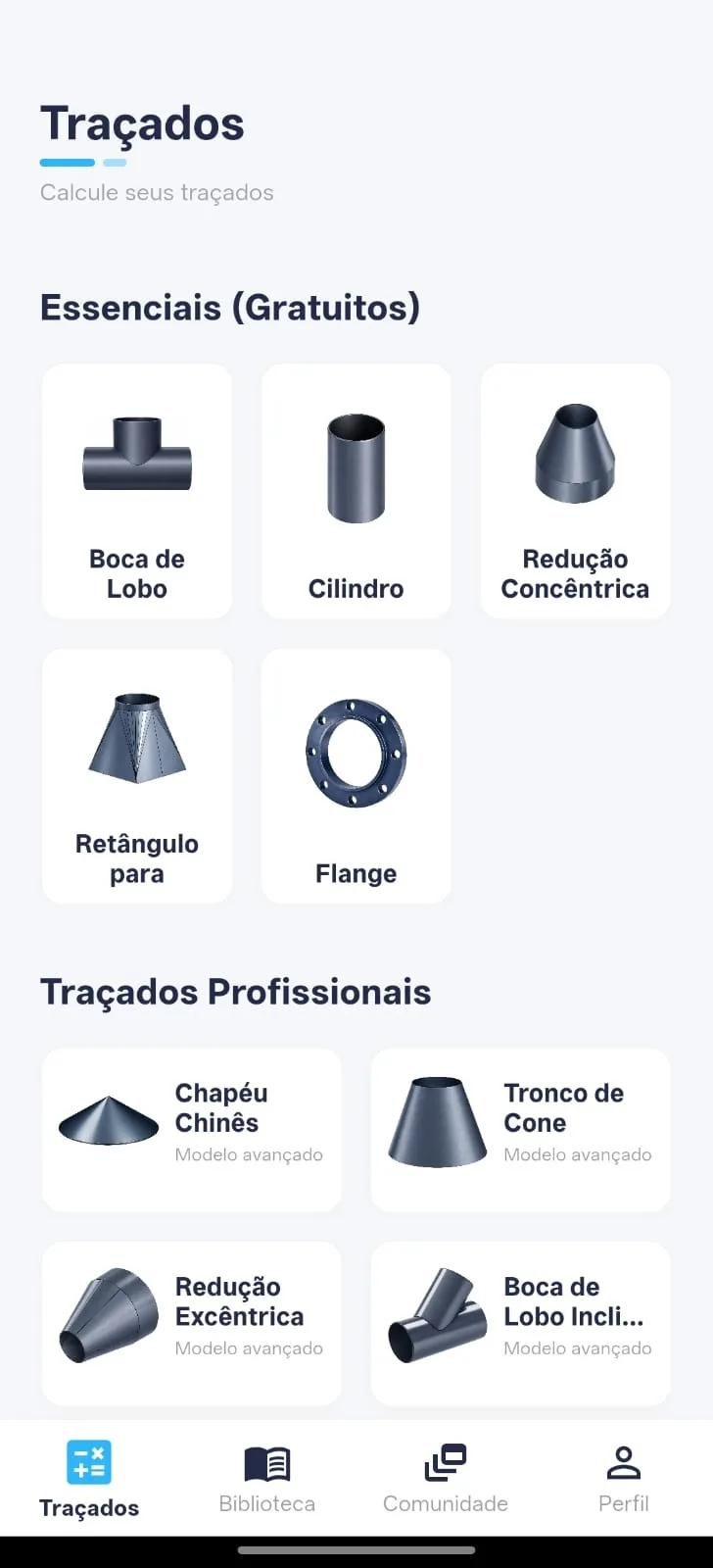
How does TraceClub help with this type of layout?
TraceClub was created to simplify the daily routine of those who work with layout of industrial boilermaking / metal fabrication.
In parts such as eccentric cone, concentric reducer, Y‑branch, conical saddle and transitions, development accuracy is essential to reduce rework and improve sheet utilization.
With the support of a digital tool, the professional can save time, organize dimensions better and avoid common interpretation errors.
The goal is not to replace the boilermaker's knowledge, but to provide more speed and safety for those who already work with this type of part in practice.
Conclusion
The difference between concentric reducer and eccentric reducer is in the alignment of the centers.
The concentric reducer has aligned centers and a symmetrical shape. The eccentric reducer has offset centers, allowing one side to remain level as required by the project.
This difference may seem small, but it completely changes the layout, the plate development, and the part’s application.
For the boilermaker, understanding this distinction is essential. Before laying out, it is necessary to confirm the dimensions, the offset, the aligned side and the assembly direction.
When these details are respected, the part becomes more accurate, the fit improves and the risk of rework decreases.
If you work in industrial boilermaking / metal fabrication and want more practicality in the development of parts, get to know TraceClub and see how technology can help in the layout of plates in everyday work.
Carry TraceClub in your pocket
Boilermaking layouts, calculations and technical manuals in the palm of your hand — fast, accurate and always with you in the shop or in the field.
- Available for iOS and Android
- Works offline
- PT · EN · ES