
Steel Plate Weight Calculation: Plate and Pipe, With Charts
Steel plate weight calculation and pipe weight per meter: the formulas behind the 7.85 density, worked examples and charts for plate and Schedule 40 pipe.
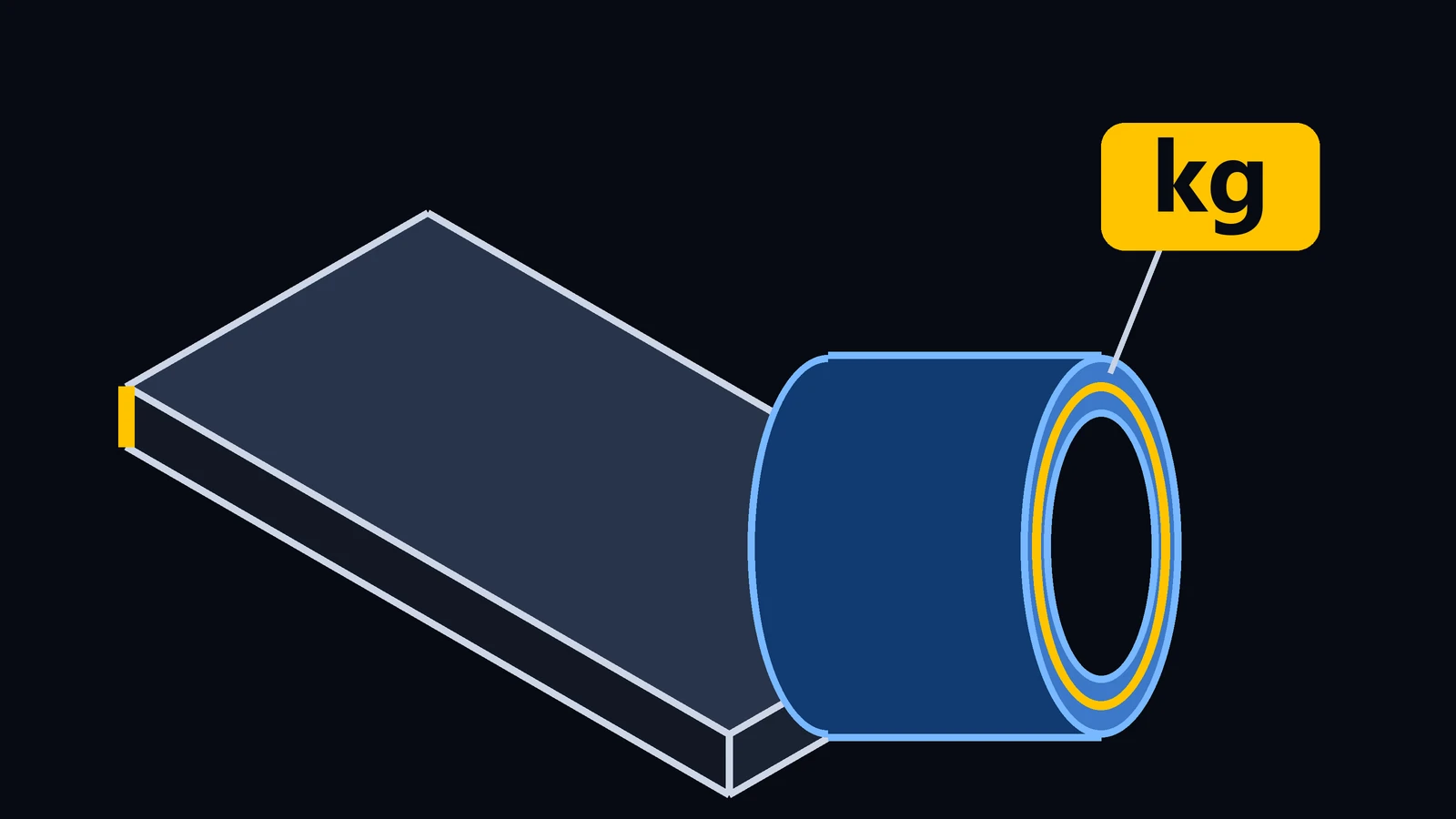
Steel plate weight calculation is part of a fabricator's everyday work: the weight goes into the estimate, the material order, the freight and, above all, the choice of lifting equipment. The rule is the same for any part: volume times density. For carbon steel it becomes two short formulas, one for plate and one for pipe.
In this article we will work with the most common case:
carbon steel parts, with a density of 7.85 kg/dm³, the value used in fabrication tables;
theoretical weight, calculated from nominal dimensions (the actual weight varies with the actual thickness of the plate or pipe);
rectangular plates, parts cut from plate and round pipe;
dimensions in millimeters and results in kilograms.
In the shop it is called weight, in kilograms; strictly speaking, the kilogram is a unit of mass. For the purpose of this article, the number is the same.
The rule: volume times density
One square meter of plate 1 mm thick has a volume of 1 dm³ (10 dm × 10 dm × 0.01 dm). Since carbon steel weighs 7.85 kg per dm³, every square meter weighs 7.85 kg for each millimeter of thickness. That is where the 7.85 in every plate weight chart comes from.
For pipe, the idea is the same: the weight of one meter of pipe is the area of the wall (the ring of the cross-section) times one meter of length times the density.
Steel plate weight calculation: the formula
With the length (L) and the width (W) in meters and the thickness (t) in millimeters:
Weight (kg) = L × W × t × 7.85
The product t × 7.85 is the weight per square meter of the plate (kg/m²). For 10 mm plate it is 78.5 kg/m²; just multiply by the area.
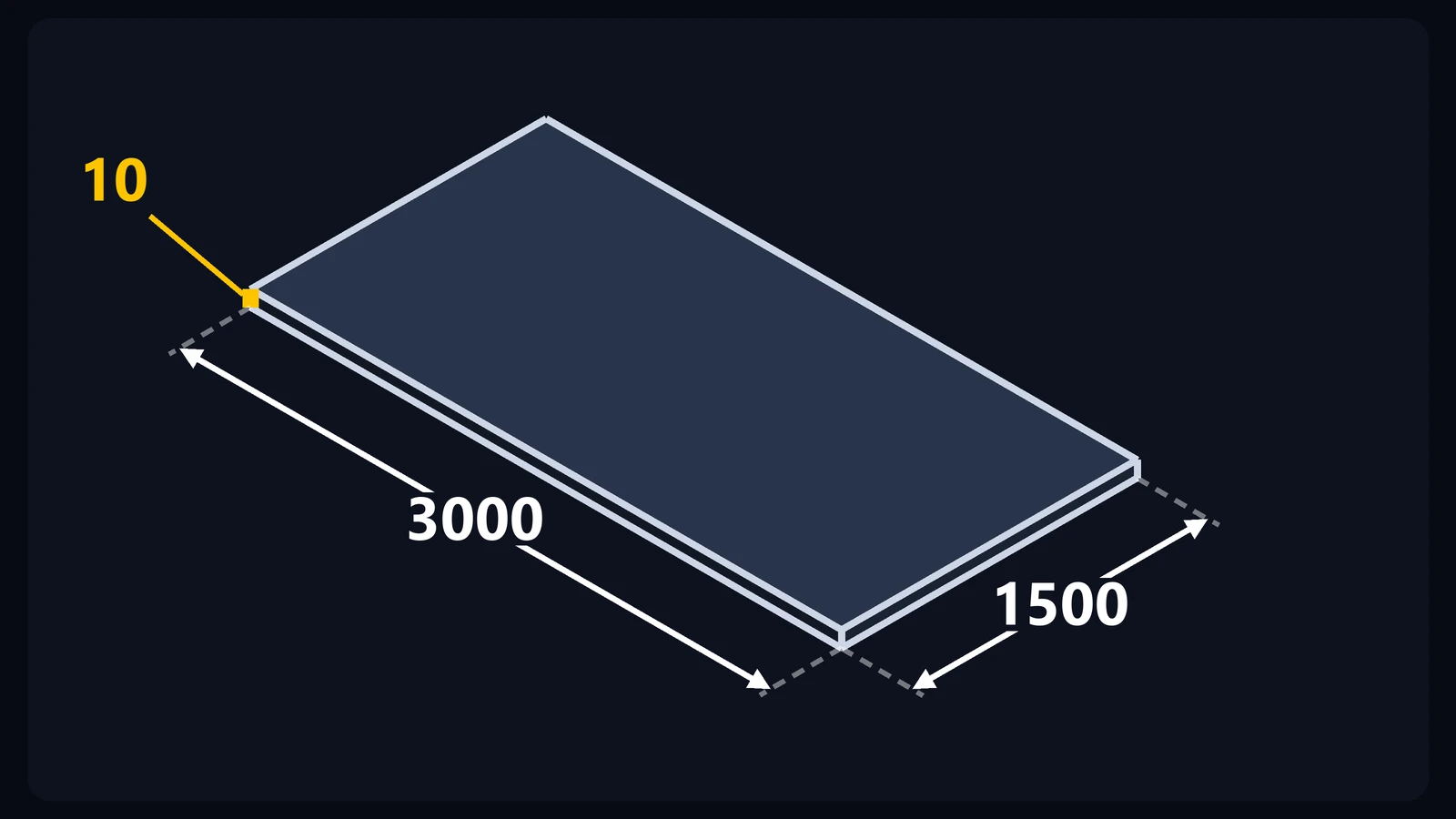
Figure 1: The plate in the example: 3,000 × 1,500 mm, 10 mm thick (in yellow). Dimensions are in millimeters; the thickness is enlarged 8 times in the drawing so it can be seen.
Example: a 3,000 × 1,500 × 10 mm plate
area: 3 × 1.5 = 4.5 m²;
weight per square meter: 10 × 7.85 = 78.5 kg/m²;
plate weight: 4.5 × 78.5 = 353.25 kg.
A part cut from plate: use the net area
For a part cut from plate, calculate the area left after the cutouts (the net area) and multiply it by the weight per square meter. Example: a disc 600 mm in diameter with a 200 mm center hole, in 12 mm plate (94.2 kg/m²).
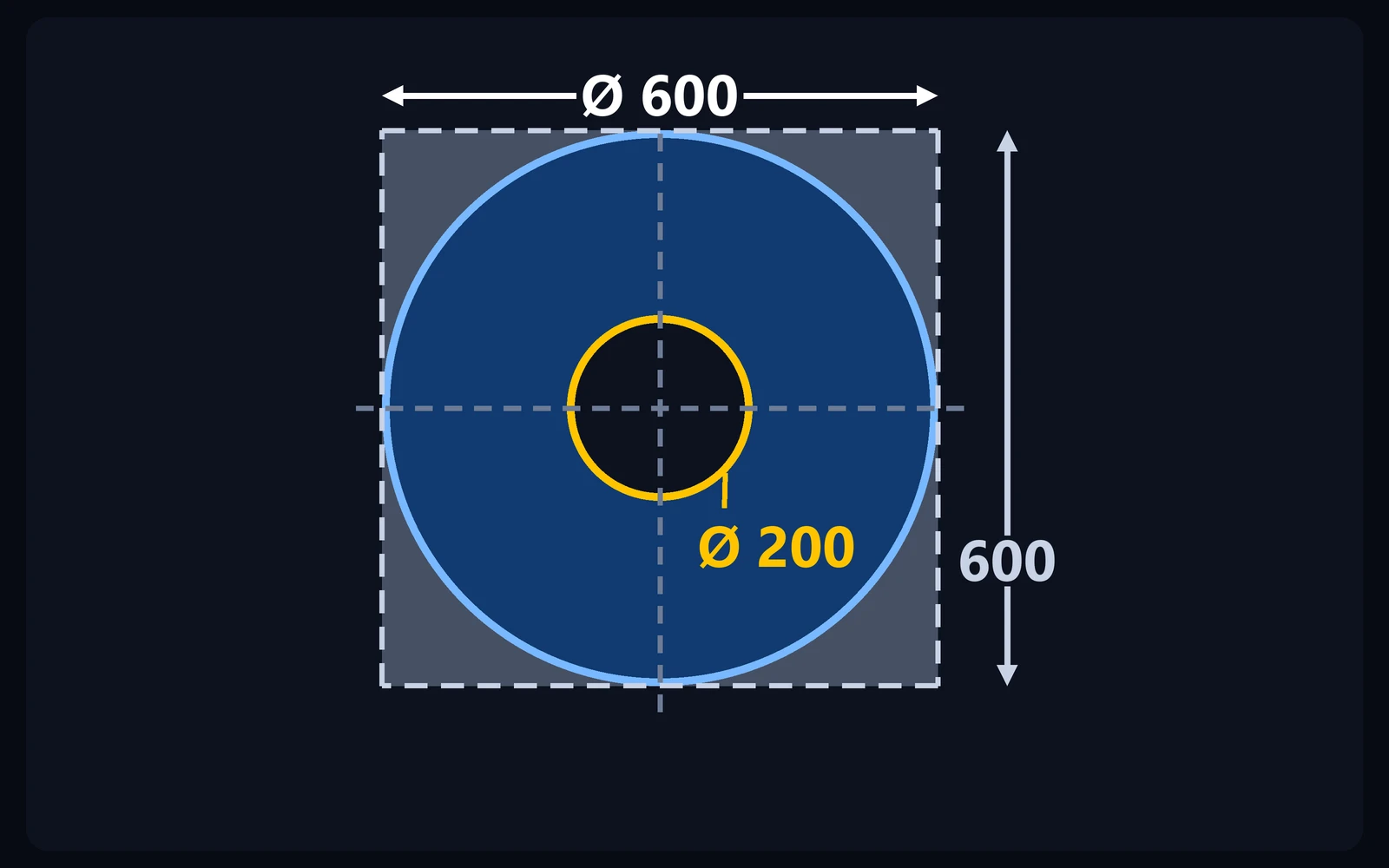
Figure 2: The disc in the example, to scale: 600 mm in diameter with a 200 mm center hole (in yellow), in 12 mm plate. The weight of the part uses only the blue area (the net area); the dashed 600 × 600 mm square is the plate you start from, and the gray corners are scrap.
area of the solid disc: π × 0.6² ÷ 4 = 0.282743 m², which would weigh 26.63 kg;
area of the hole: π × 0.2² ÷ 4 = 0.031416 m²;
net area: 0.282743 − 0.031416 = 0.251327 m²;
weight of the disc: 0.251327 × 94.2 = 23.68 kg;
the plate the disc is cut from (600 × 600 mm): 0.36 × 94.2 = 33.91 kg. That is the weight you buy; 33.91 − 23.68 = 10.23 kg become scrap.
How to calculate pipe weight per meter
With the outside diameter (OD) and the wall thickness (t) in millimeters, the weight of one meter of carbon steel pipe is:
Weight (kg/m) = 0.0246615 × t × (OD − t)
The formula is not an approximation. The area of the ring, π ÷ 4 × (OD² − ID²), with the inside diameter ID = OD − 2t, is exactly π × t × (OD − t): the pipe wall, opened out flat, is a strip of thickness t whose length is the circumference at mid-wall, π × (OD − t). The constant combines π, the density and the unit conversion: π × 7.85 = 24.6615, divided by 1,000, gives 0.0246615. It is the same constant used in the pipe tables of ASME B36.10M.
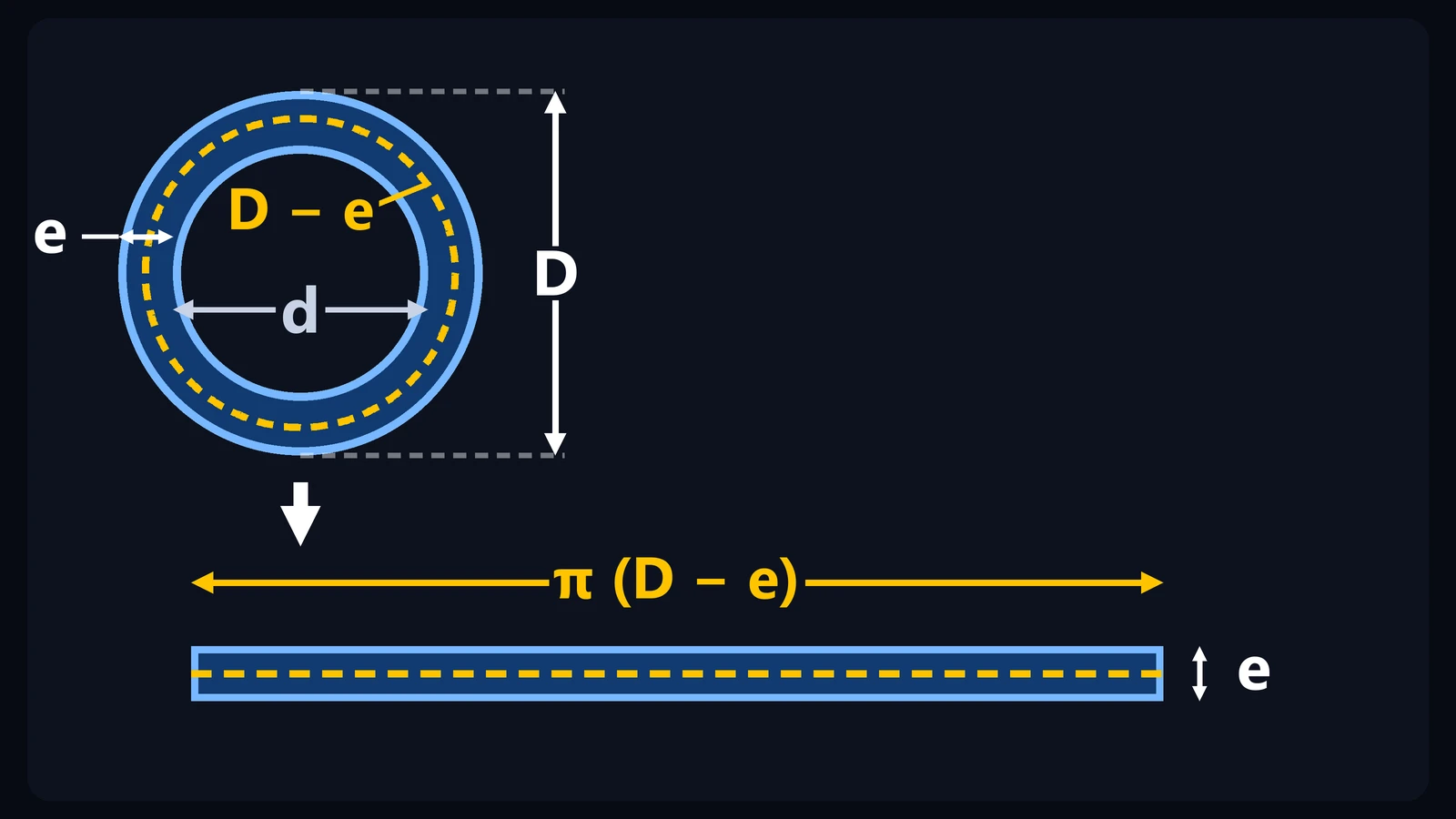
Figure 3: The pipe cross-section (top) and the same wall opened out into a strip (bottom), at the same scale. In the drawing, D is the outside diameter, d the inside diameter and e the wall thickness, called t in the text. The yellow line is the mid-wall, with a diameter of D − e (OD − t in the text); opened out, it measures π (D − e), and the strip has the same area as the ring. The thickness is enlarged in the drawing.
Example: 114.3 × 6.02 mm pipe
This is NPS 4" Schedule 40 (Sch. 40) pipe. For a 6 m length:
mid-wall diameter: 114.3 − 6.02 = 108.28 mm;
weight per meter: 0.0246615 × 6.02 × 108.28 = 16.08 kg/m;
check with the area: the ring has 2,047.83 mm², and 2,047.83 × 0.00785 gives the same 16.08 kg/m;
6 m length: 16.08 × 6 = 96.48 kg.
Carry TraceClub in your pocket
Boilermaking layouts, calculations and technical manuals in the palm of your hand — fast, accurate and always with you in the shop or in the field.
- Available for iOS and Android
- Works offline
- PT · EN · ES
Steel plate weight chart by thickness
Values of t × 7.85, plus the weight of a 3,000 × 1,500 mm plate (4.5 m²):
Thickness (mm) | Weight (kg/m²) | 3,000 × 1,500 plate (kg) |
|---|---|---|
3 | 23.55 | 105.98 |
4.75 | 37.29 | 167.79 |
6.3 | 49.46 | 222.55 |
8 | 62.80 | 282.60 |
9.5 | 74.58 | 335.59 |
12.5 | 98.13 | 441.56 |
16 | 125.60 | 565.20 |
19 | 149.15 | 671.18 |
25 | 196.25 | 883.13 |
Steel pipe weight chart (Schedule 40)
NPS 2" to 10" Schedule 40 pipe, with the outside diameter and wall thickness from ASME B36.10M. The weights per meter calculated with the formula match the standard's. For the 6": 168.3 − 7.11 = 161.19, and 0.0246615 × 7.11 × 161.19 = 28.26 kg/m.
Pipe (NPS) | OD (mm) | t (mm) | Weight (kg/m) | 6 m length (kg) |
|---|---|---|---|---|
2" | 60.3 | 3.91 | 5.44 | 32.64 |
3" | 88.9 | 5.49 | 11.29 | 67.74 |
4" | 114.3 | 6.02 | 16.08 | 96.48 |
6" | 168.3 | 7.11 | 28.26 | 169.56 |
8" | 219.1 | 8.18 | 42.55 | 255.30 |
10" | 273.1 | 9.27 | 60.31 | 361.86 |
The 6 m length column is the weight per meter in the chart times 6.
What about other materials?
Replace 7.85 with the density of the material, or multiply the result by the ratio of the densities. Stainless steel is slightly denser, depending on the alloy; with 8.00 kg/dm³ (the value in the Petrobras fabrication manual table), the factor is 8.00 ÷ 7.85 = 1.019, and the pipe in the example becomes 16.08 × 1.019 = 16.39 kg/m (16.39 − 16.08 = 0.31 kg/m more). For other materials, use the density given by the supplier.
Step by step: how to calculate the weight
Confirm the material and its density: 7.85 kg/dm³ for carbon steel.
Measure the part in millimeters. For pipe, use the outside diameter (from the pipe table or measured), not the nominal size in inches.
For plate, convert the length and width to meters and calculate the area. Subtract holes and cutouts.
Multiply the area by the thickness in millimeters and by 7.85.
For pipe, calculate OD − t (the diameter at mid-wall).
Multiply 0.0246615 × t × (OD − t) to get the weight per meter.
Multiply the weight per meter by the length of the pipe, in meters.
Add up the parts of an assembly and check that the result makes sense against the charts.
Common mistakes in steel plate weight calculation and pipe weight
1. Using the inside diameter in the pipe formula
The formula needs the outside diameter. In the example, the inside diameter is 114.3 − 12.04 = 102.26 mm; used instead of the outside diameter, it gives 102.26 − 6.02 = 96.24 and 14.29 kg/m. That is 16.08 − 14.29 = 1.79 kg/m less, about 11 %.
2. Using the nominal size in inches as the diameter
A 4" pipe does not have a 101.6 mm outside diameter: it is 114.3 mm. Always use the outside diameter from the pipe table, or a measured one.
3. Mixing millimeters and meters
In the plate formula, the length and width go in meters and the thickness in millimeters. With all three in millimeters, the result comes out a million times too large; with all three in meters, a thousand times too small.
4. Forgetting holes and cutouts, or forgetting the scrap
The weight of the finished part uses the net area; the weight you buy uses the full plate. For the disc in the example, the difference is 10.23 kg.
5. Using the carbon steel constant for another material
The 7.85 and the 0.0246615 apply to carbon steel. For stainless steel, aluminum or another alloy, correct for the density.
Frequently asked questions
How much does one square meter of 1 mm steel plate weigh?
7.85 kg. For another thickness, multiply: 10 mm plate weighs 78.5 kg/m².
Where does the 0.02466 in the pipe formula come from?
It is π × 7.85 ÷ 1,000 = 0.0246615, which charts round to 0.02466. It turns the area of the ring, in mm², into kilograms per meter of carbon steel.
How do I calculate the weight of square or rectangular tubing?
With sharp corners, the wall area is 2 × t × (B + H − 2t), where B and H are the outside sides. For 50 × 50 × 3 mm, B + H − 2t is 94 mm, the area is 2 × 3 × 94 = 564 mm² and the weight, 4.43 kg/m. For tubing with rounded corners, the area changes with the corner radius and the manufacturing tolerance: for the catalog value, use the manufacturer's chart.
How much does the plate for a shell course weigh?
Calculate the blank length from the mean diameter (see blank length for rolling a cylinder) and apply the plate formula. Shell course with a 1,000 mm outside diameter, 8 mm plate and a height of 1.5 m: 1,000 − 8 = 992, a blank of 3.1416 × 992 = 3,116.47 mm and a weight of 293.57 kg. The pipe formula gives the same: 195.71 kg/m × 1.5 m.
Is the actual weight the same as the theoretical weight?
Not exactly. The actual thickness and diameter vary within the manufacturing tolerance, and the actual weight follows. For lifting, use the weight from the certificate or a scale, when available, and the margin set in the lift plan.
See also
Blank Length for Rolling a Cylinder (Shell Course): Step by Step
What is industrial boilermaking layout? Practical guide for boilermakers
Summary
Carbon steel plate weight: L (m) × W (m) × t (mm) × 7.85, with the net area for parts cut from plate. Carbon steel pipe weight: 0.0246615 × t × (OD − t) kilograms per meter, using the outside diameter. For another material, correct for the density.
Important
The values in this article are theoretical weights of carbon steel, calculated from nominal dimensions. Do not rely on the theoretical weight alone to plan a lift: check the weight on the material certificate or with a scale, add the weight of the rigging and any below-the-hook lifting devices, and follow the lift plan and lifting procedure of your workplace.
Carry TraceClub in your pocket
Boilermaking layouts, calculations and technical manuals in the palm of your hand — fast, accurate and always with you in the shop or in the field.
- Available for iOS and Android
- Works offline
- PT · EN · ES