
45 Degree Pipe Offset Calculation: Travel and Cut Length
45 degree pipe offset calculation: the 1.41421 factor, the elbow center-to-end distance, the cut length of the inclined pipe, the rolling offset and a ready chart.
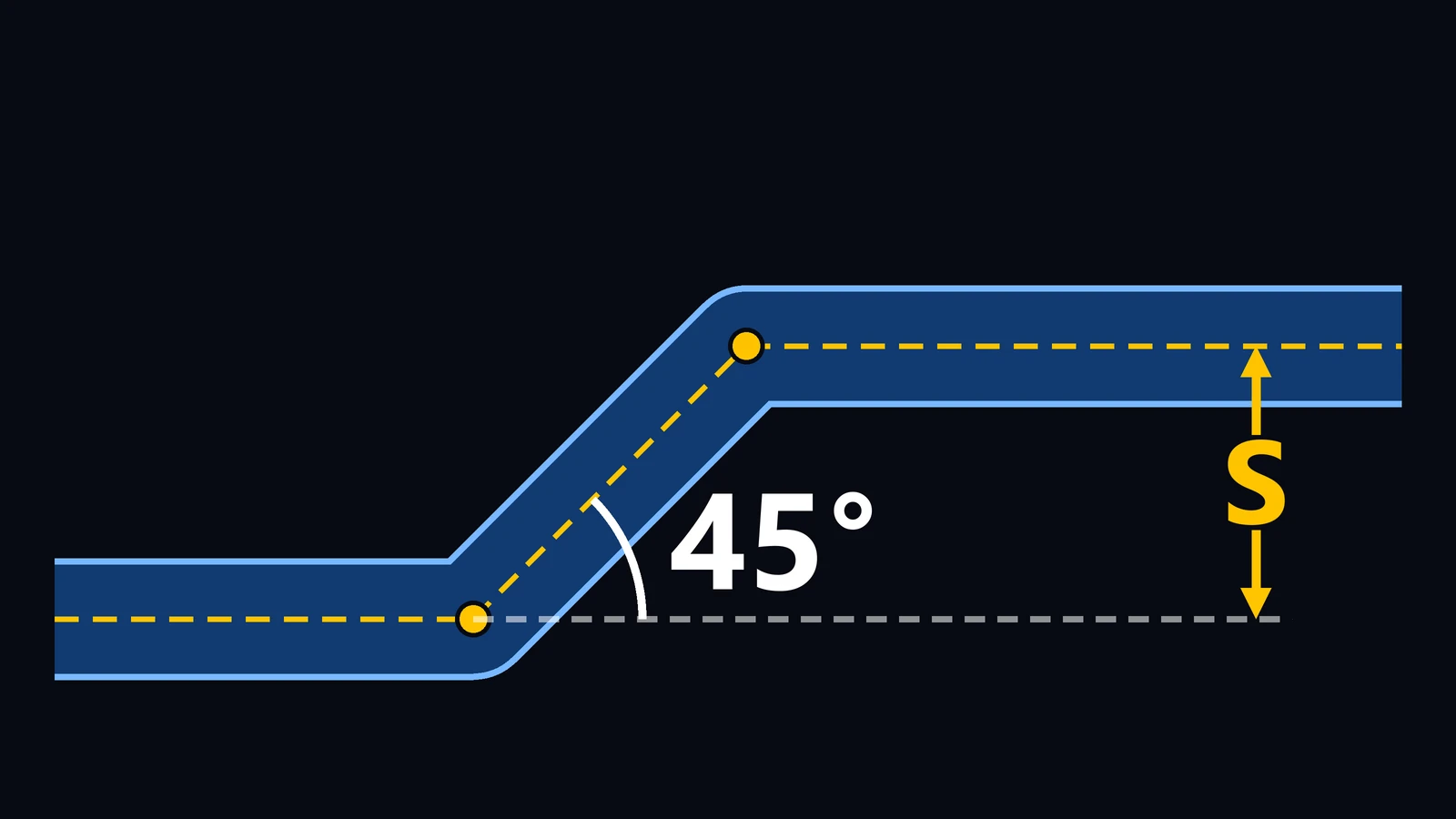
A 45 degree pipe offset moves the line from one centerline to another, parallel to the first, with two 45° elbows joined by an inclined pipe. What the fitter needs from the 45 degree pipe offset calculation is how long that inclined pipe is and how much to cut, after allowing for the elbows. The calculation is short and always the same: a factor of 1.41421 and the center-to-end distance of the elbow from the fitting table.
In this article we will work with the most common case:
two parallel pipes with their centerlines a distance S apart (the offset);
two equal 45° long radius butt-weld elbows joined by an inclined pipe;
dimensions taken between centerlines, center to center;
dimensions in millimeters.
45 degree pipe offset calculation: the rule
We call S the offset (the distance between the centerlines of the two parallel pipes) and L the length of the inclined pipe (the travel), measured from elbow center to elbow center. The center of the elbow is the point where the centerlines of the pipes it joins cross.
The travel (the inclined pipe), the offset S and the run (the projection of the travel along the parallel pipes) form a right triangle with a 45° angle. So the two legs are equal: the run is also S. The hypotenuse is L = S ÷ sin 45° = S × 1.41421, because sin 45° = 0.70711.
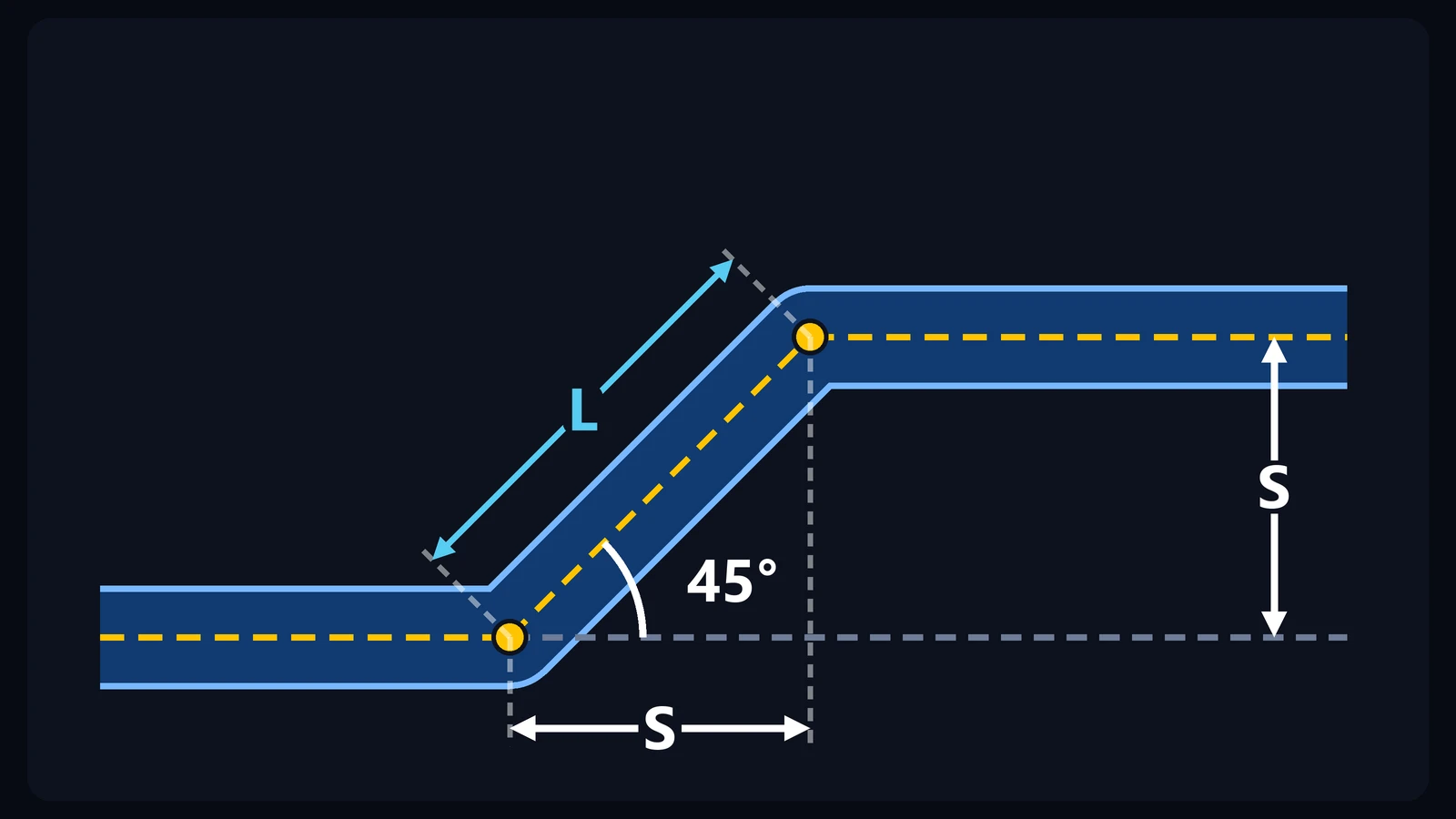
Figure 1: The offset in the example: S is the offset between the centerlines (vertical), the run is also S (horizontal) and L is the inclined travel, from elbow center to elbow center (the yellow dots). The pipe diameter is exaggerated in the drawing.
From center to center to the cut length
The inclined pipe is not L long: the two elbows take up part of it. Each 45° elbow has a center-to-end distance C (also called center-to-face distance, or take-off): the distance from the center of the elbow to its end (the face where the pipe butts). The pipe between the elbow ends is L − 2C long.
The center-to-end distance comes from the manufacturer's table, which follows ASME B16.9. By geometry, C = R × tan 22.5° = 0.41421 × R, where R is the bend radius of the elbow (for long radius, R = 1.5 × NPS in inches × 25.4 mm). For the 4" elbow, R = 1.5 × 4 × 25.4 = 152.4 mm and 0.41421 × 152.4 = 63.13 mm; the table gives 63.5 mm (2.5 in). Always use the manufacturer's value.
On butt welds, the pipe is also cut shorter by the root gap (g) of each weld: cut length = L − 2C − 2g.
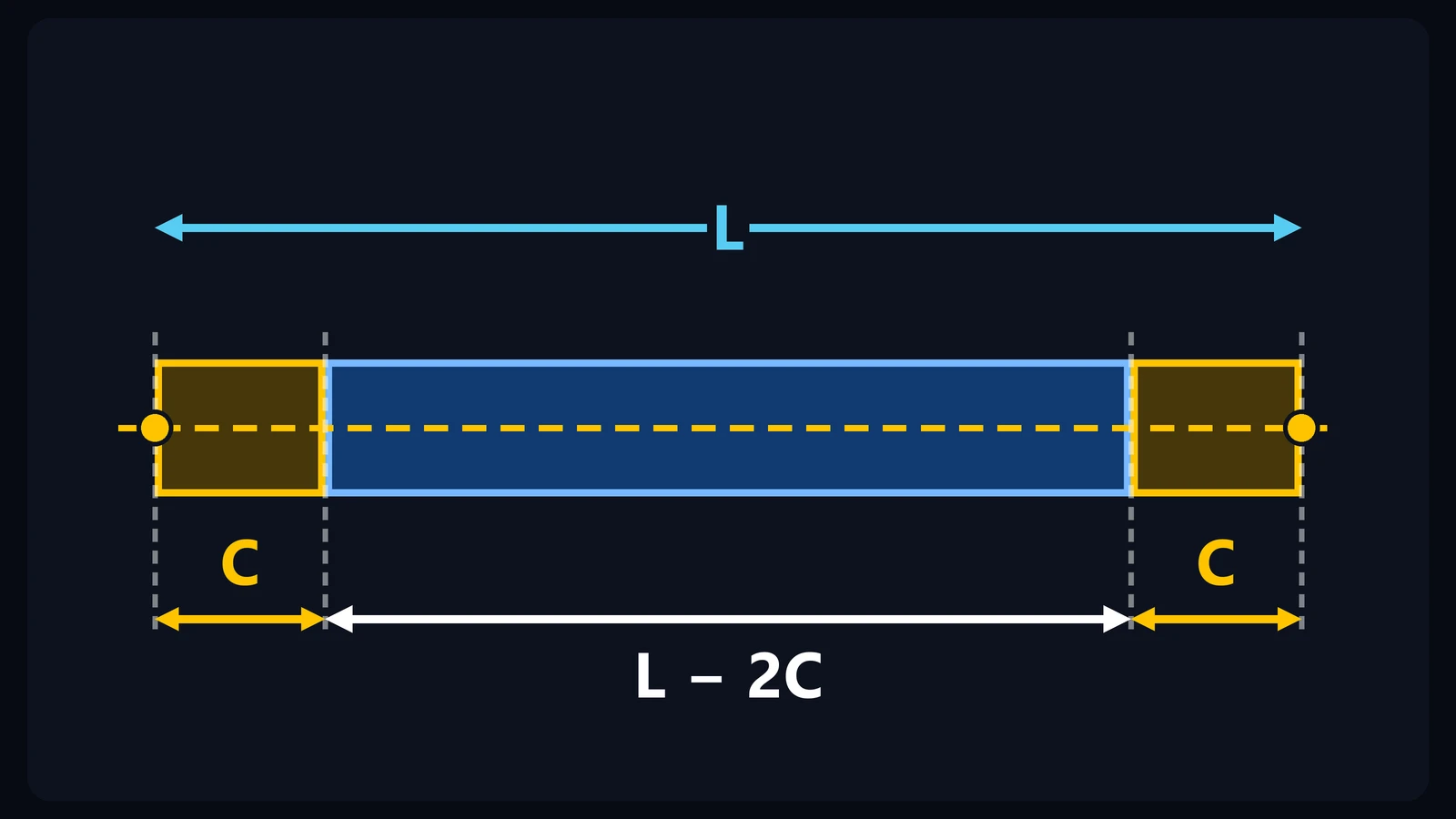
Figure 2: The inclined pipe laid out flat: L is the center-to-center length, C is the center-to-end distance of each elbow (from the center of the elbow to its end, in yellow) and the pipe between the elbows is L − 2C (in blue). The ratio C ÷ L is the one in the example; the root gap is not drawn.
Example: a 300 mm offset in 4" pipe
offset: S = 300 mm; the run is also 300 mm;
travel, center to center: 300 × 1.41421 = 424.26 mm;
center-to-end distance of the two elbows: 2 × 63.5 = 127 mm;
pipe between the elbow ends: 424.26 − 127 = 297.26 mm;
with a root gap of 2 mm at each weld: 2 × 2 = 4 mm;
pipe to cut: 297.26 − 4 = 293.26 mm.
Rolling offset: rise and roll at the same time
When the offset rises and moves sideways at the same time, the true offset S is the diagonal between the rise (H) and the roll (B), measured between centerlines: S = √(H² + B²). After that, everything is the same: L = S × 1.41421.
Example: rise 300 mm and roll 400 mm
300 × 300 = 90,000 and 400 × 400 = 160,000; 90,000 + 160,000 = 250,000;
true offset: √250,000 = 500 mm;
travel, center to center: 500 × 1.41421 = 707.11 mm;
between the ends of the 4" elbows: 707.11 − 127 = 580.11 mm;
pipe to cut, with 2 × 2 = 4 mm of root gap: 580.11 − 4 = 576.11 mm.
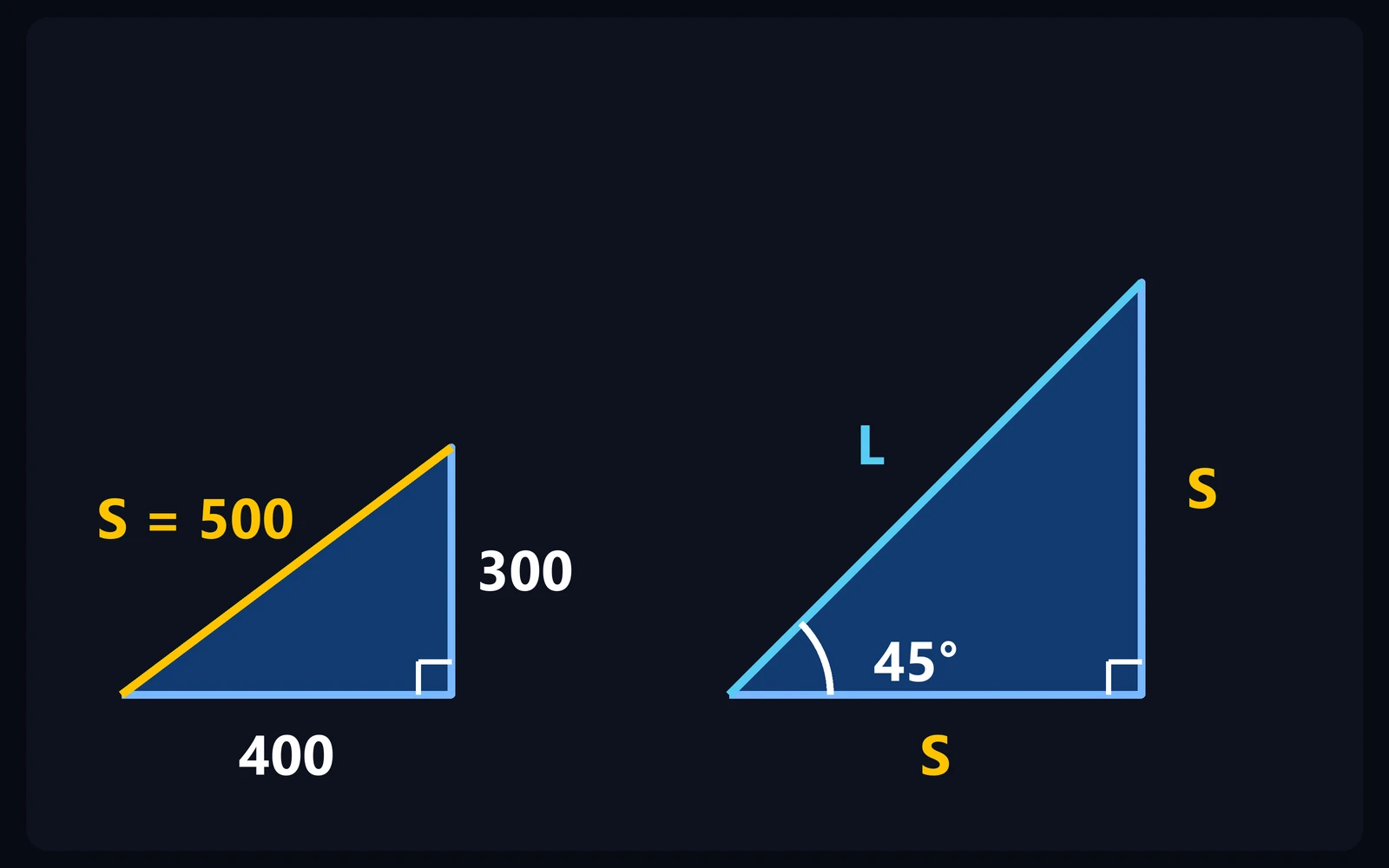
Figure 3: On the left, the rise (300) and the roll (400) of the example give the true offset S = 500, the diagonal. On the right, with S on both legs and the 45° angle, the hypotenuse is the inclined travel L = S × 1.41421. Dimensions in millimeters, to scale.
Both elbows lie in the same plane, and that plane is rotated about the pipe axis by an angle θ from the horizontal, with tan θ = H ÷ B (in the example, 36.87°). Everything happens in that plane: the line leaves the first pipe and, after the second elbow, is parallel to it again.
Carry TraceClub in your pocket
Boilermaking layouts, calculations and technical manuals in the palm of your hand — fast, accurate and always with you in the shop or in the field.
- Available for iOS and Android
- Works offline
- PT · EN · ES
45 degree offset chart: travel and cut length
For 4" long radius 45° elbows (center-to-end distance of 63.5 mm) and a root gap of 2 mm:
Offset S (mm) | Travel L (mm) | Pipe to cut (mm) |
|---|---|---|
100 | 141.42 | 10.42 |
150 | 212.13 | 81.13 |
200 | 282.84 | 151.84 |
250 | 353.55 | 222.55 |
300 | 424.26 | 293.26 |
400 | 565.69 | 434.69 |
500 | 707.11 | 576.11 |
600 | 848.53 | 717.53 |
The pipe to cut is L − 127 − 4. For another pipe size or another elbow, change the center-to-end distance. L is calculated with the exact √2; with 1.41421 the difference is up to 0.01 mm. With S below 92.63 mm (131 ÷ 1.41421), no pipe is left between the elbows.
What if the elbows are not 45°?
For an angle α, L = S ÷ sin α, the run is S ÷ tan α and the center-to-end distance, by geometry, is R × tan(α ÷ 2). With the 4" long radius elbow (R = 152.4 mm):
α (degrees) | L ÷ S | Run ÷ S | C = R × tan(α ÷ 2) (mm) |
|---|---|---|---|
22.5 | 2.61313 | 2.41421 | 30.31 |
30 | 2.00000 | 1.73205 | 40.84 |
45 | 1.41421 | 1.00000 | 63.13 |
60 | 1.15470 | 0.57735 | 87.99 |
Only at 45° is the run equal to the offset, which keeps the arithmetic simple.
Step by step: 45 degree pipe offset calculation
Measure the offset S between the centerlines of the two parallel pipes. If the offset is rolling, measure the rise H and the roll B and calculate S = √(H² + B²).
Calculate the travel, center to center: L = S × 1.41421.
Take the center-to-end distance C of the 45° elbow from the manufacturer's table (long radius, butt weld, your NPS).
Calculate the pipe between the elbow ends: L − 2C.
Allow for the root gap of each weld: cut length = L − 2C − 2g.
Mark the length on the pipe with a line at 90° to the axis, and cut.
Bevel the ends and fit up in order: first pipe, elbow, inclined pipe, elbow, last pipe.
Check the result: the distance between the centerlines must be S, and the two straight pipes must be parallel.
Common mistakes in 45 degree pipe offset calculations
1. Cutting the pipe at the center-to-center length
Cutting L instead of L − 2C − 2g leaves the pipe 127 + 4 = 131 mm too long in the example, and the offset comes out bigger than asked.
2. Measuring the offset between pipe walls instead of centerlines
S is measured between centerlines. Measuring between the two farthest outer walls on two 114.3 mm OD pipes, the distance is 414.3 mm, and 414.3 − 114.3 = 300 mm is the offset.
3. Multiplying by 0.70711 instead of 1.41421
The factor 0.70711 is for the way back (S = L × 0.70711). To find L from S, 300 × 0.70711 = 212.13 mm is half the right value.
4. Forgetting the root gap
With 2 mm at each weld, that is 4 mm. On successive offsets, this error adds up.
5. Adding the rise and the roll
On a rolling offset, 300 + 400 = 700 mm is not the offset: the right value is the diagonal, 500 mm. With 700, L would come out 700 × 1.41421 = 989.95 mm, 989.95 − 707.11 = 282.84 mm too long.
45 degree pipe offset calculation: frequently asked questions
What is the factor for a 45 degree offset?
The factor is 1.41421: the travel, center to center, is the offset times 1.41421, and the run is equal to the offset.
Can I use 1.414 instead of 1.41421?
In practice, yes. With S = 500 mm, 500 × 1.414 = 707.00 mm against 707.11 mm: 707.11 − 707.00 = 0.11 mm of difference. For large pipe or many offsets in a row, use the full factor.
Where do I find the center-to-end distance of the elbow?
In the manufacturer's table, which follows ASME B16.9. For 45° long radius elbows, NPS 4 has 2.5 in (63.5 mm), NPS 6 has 3.75 in (95.25 mm) and NPS 8 has 5 in (127 mm). Tables in millimeters may show 64 mm for NPS 4, rounded.
Is there a short radius 45° elbow?
Not in the ASME B16.9 and B16.28 series: short radius exists only in 90° and 180° elbows, and the 45° elbow is long radius, the one in this article. If your elbow has another radius R, the geometry gives C = 0.41421 × R, but ask the manufacturer for the center-to-end distance.
Can I work out the cut length without the elbow table?
Yes, by geometry: C = 0.41421 × R. But the manufacturer's table takes precedence: for the 4" long radius elbow, the geometry gives 63.13 mm and the table 63.5 mm, 0.37 mm more per elbow.
See also
Summary
45 degree pipe offset: L = S × 1.41421 (center to center) and run equal to S; pipe to cut = L − 2C − 2g, with C from the manufacturer's table and g the root gap. On a rolling offset, S = √(H² + B²).
Important
The values in this article are for 45° long radius butt-weld elbows, with the center-to-end distance from the ASME B16.9 table. Always confirm the center-to-end distance of the elbow and the root gap in the manufacturer's catalog and in the welding procedure of your job before cutting. The article does not replace the design, the standard or the assembly procedure of your workplace.
Carry TraceClub in your pocket
Boilermaking layouts, calculations and technical manuals in the palm of your hand — fast, accurate and always with you in the shop or in the field.
- Available for iOS and Android
- Works offline
- PT · EN · ES