
Frustum of a Pyramid Pattern: Square Hopper Layout, Step by Step
Frustum of a pyramid pattern for a rectangular or square hopper: true lengths, step-by-step method and a measurement table.
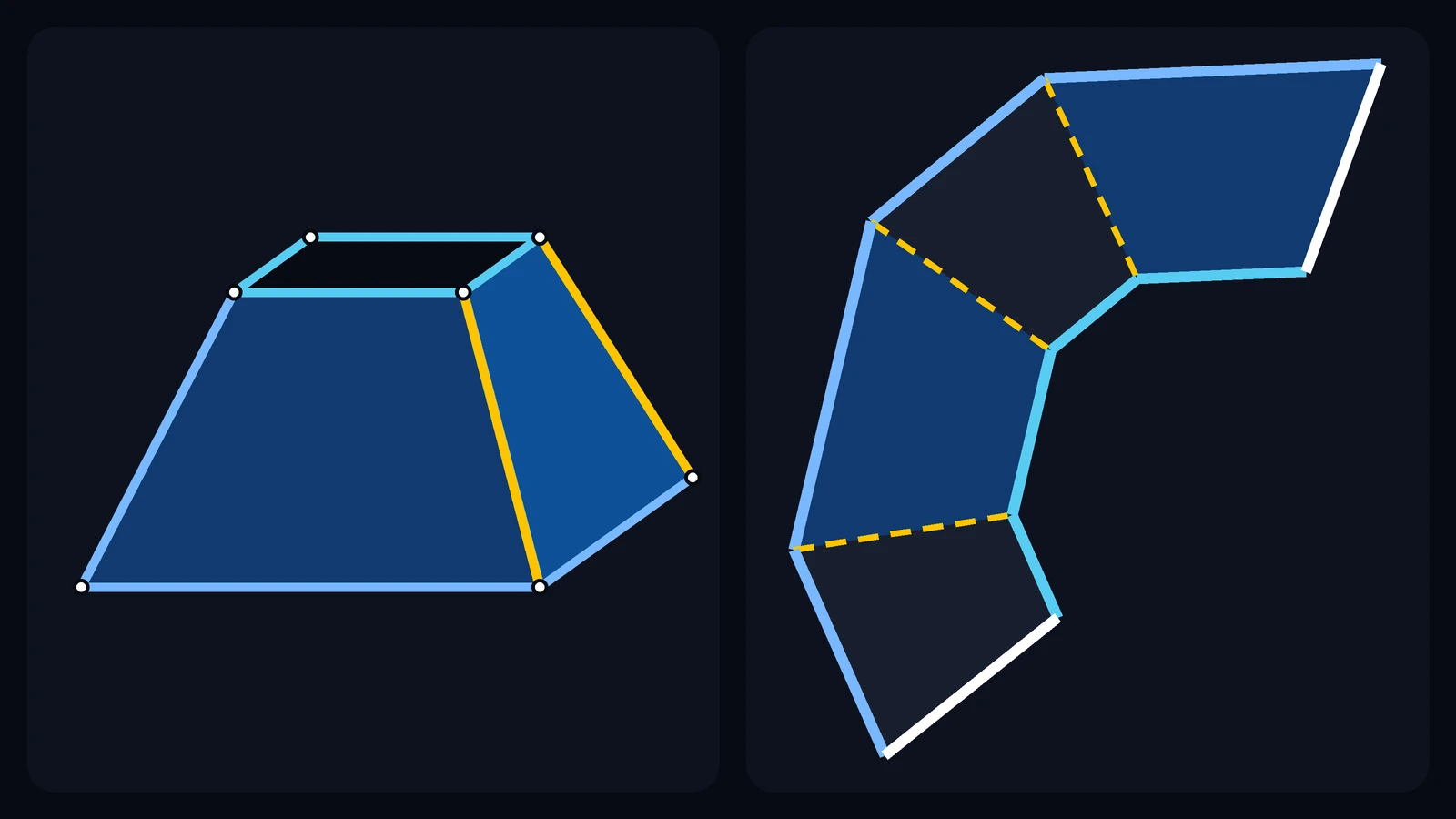
The frustum of a pyramid pattern is the flat layout of the sheet that, welded or folded along its edges, forms a rectangular or square hopper. Every line of the pattern must show the true length of the line it stands for, and what is still missing is the true height of each face and the true length of the lateral edges, which do not always show in true length in the views.
In this article we work with one specific piece:
a right frustum of a pyramid with a rectangular (or square) large base, whose small base is parallel to it, centered on it and similar to it (m ÷ A = n ÷ B);
four lateral faces, all isosceles trapezoids, laid out on a single sheet with the seam along one edge;
known measurements: the sides of both bases and the vertical height of the piece.
A small base that is off center (an oblique frustum), a truncated cone and a square-to-round transition need other layouts: see how to lay out a truncated cone and the square-to-round layout.
What changes in a frustum of a pyramid: the true lengths
Each lateral face is an isosceles trapezoid: its bases are one side of the large base and the matching side of the small base, and its two legs are lateral edges, all of the same length (k). To draw the trapezoid on the sheet, two measurements are missing: the height of the face and the length of the edge. The height s of the face and the edge k are inclined to the planes of the views and look shorter than they are; the height t shows in true length in the front view, where the face on side B is seen edge-on, but it is safer to get all three the same way. You have to find the true length of each one, with a right triangle drawn beside the views or by calculation.
Call the sides of the large base A and B, the matching sides of the small base m and n (m parallel to A and n parallel to B), and the vertical height H. Seen from above, the sides of the small base are set in from those of the large one by u = (A − m) ÷ 2 along A and v = (B − n) ÷ 2 along B. The three true lengths come from right triangles:
s = √(H² + v²): height of the faces on sides A (the ones with bases A and m);
t = √(H² + u²): height of the faces on sides B (the ones with bases B and n);
k = √(H² + u² + v²): lateral edge, which also equals √(s² + u²) and √(t² + v²).
Note that the height of the face (s or t) is not the height H of the piece, and that the edge k is longer than the one that shows in the front view, where only u and H can be seen.
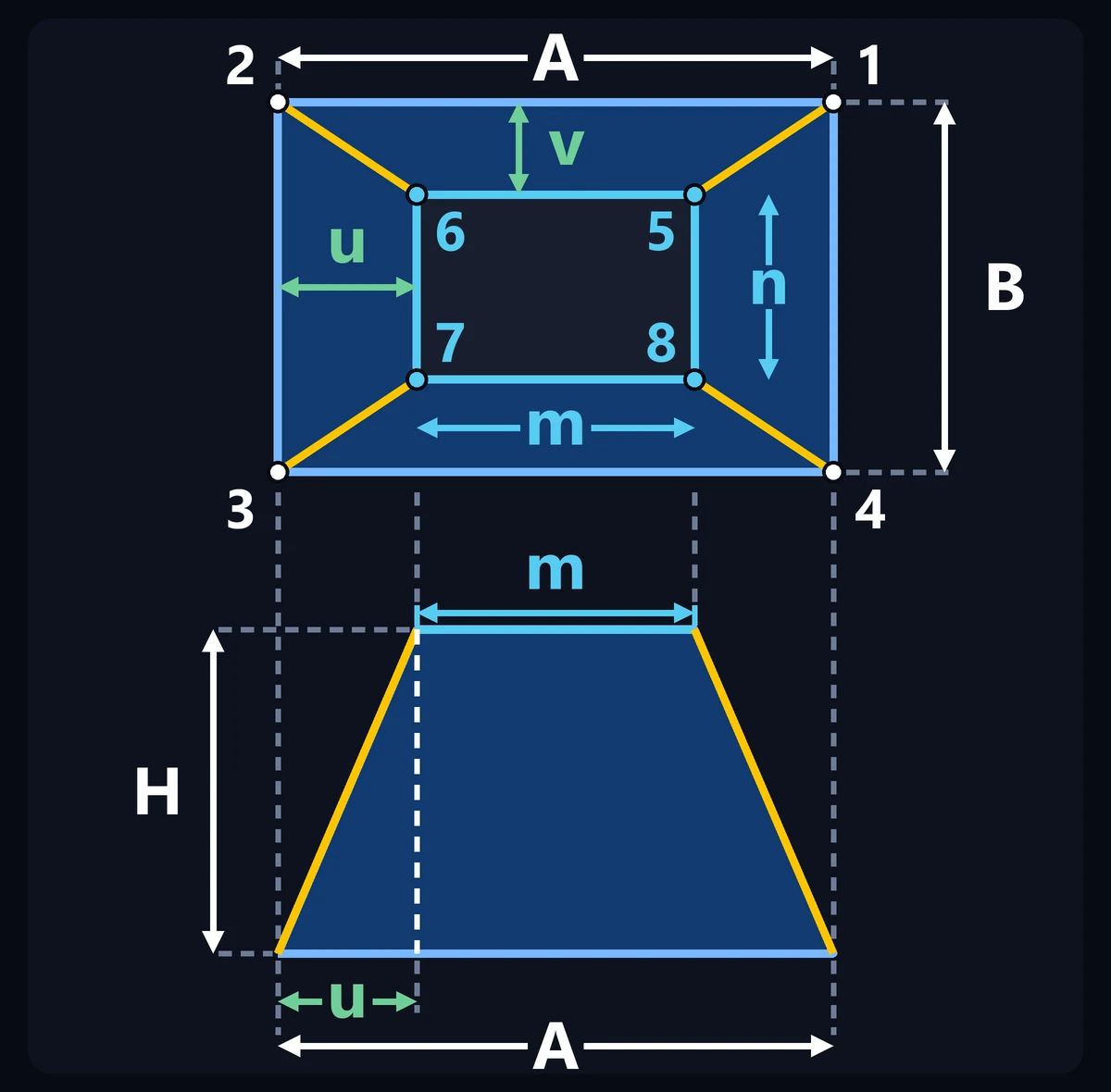
Figure 1: The two views of the frustum, on the same scale and lined up. Top: the top view, with the large base (A × B, corners 1 to 4), the small base (m × n, corners 5 to 8), the lateral edges in yellow and the insets u and v in green. Bottom: the front view, with the height H; the dashed vertical lines link the corners. In this view the edge looks foreshortened, because only u and H can be seen.
Measurements you need
Measurement | Meaning |
|---|---|
A and B | Sides of the large base (in the square case, A = B) |
m and n | Sides of the small base: m parallel to A, n parallel to B, with m ÷ A = n ÷ B |
H | Vertical height of the piece, between the planes of the two bases |
u and v | How far the small base is set in: u = (A − m) ÷ 2 and v = (B − n) ÷ 2 |
s, t and k | True lengths: height of the faces on A, height of the faces on B and lateral edge |
In the example, the large base measures A = 600 mm by B = 400 mm, the small base measures m = 300 mm by n = 200 mm, and the height is H = 350 mm. The proportions match: 300 ÷ 600 = 200 ÷ 400 = 0.5.
Step-by-step frustum of a pyramid pattern (hopper layout)
Step 1 — Draw the views and number the corners
Draw the top view (plan) and, lined up with it, the front view (elevation). The top view holds the two concentric rectangles, A × B and m × n; the front view, the trapezoid of height H. Number the corners of the large base 1 to 4 and those of the small base 5 to 8, so that 5 sits over 1, 6 over 2, 7 over 3 and 8 over 4. The lateral edges are 1–5, 2–6, 3–7 and 4–8.
Step 2 — Calculate the insets
u = (A − m) ÷ 2 = (600 − 300) ÷ 2 = 150 mm and v = (B − n) ÷ 2 = (400 − 200) ÷ 2 = 100 mm.
Step 3 — Find the true lengths
With the measurements of the example:
s = √(350² + 100²) = √(122,500 + 10,000) = √132,500 = 364.01 mm;
t = √(350² + 150²) = √(122,500 + 22,500) = √145,000 = 380.79 mm;
k = √(350² + 150² + 100²) = √(122,500 + 22,500 + 10,000) = √155,000 = 393.70 mm.
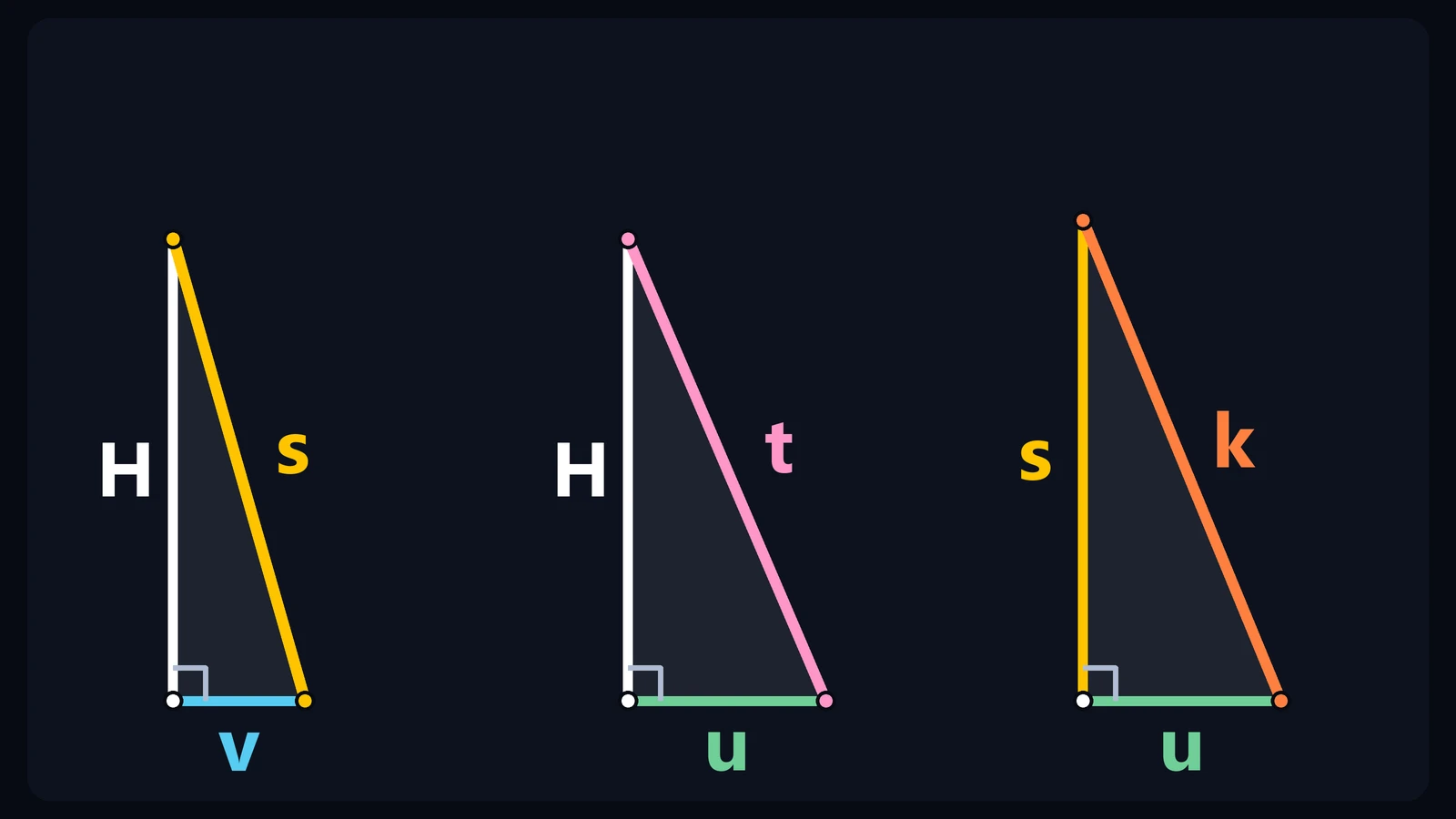
Figure 2: The true lengths, drawn to scale and on the same scale in all three triangles. Left: the height s of the faces on sides A, the hypotenuse of the triangle with legs H and v. Middle: the height t of the faces on sides B, with legs H and u. Right: the lateral edge k, the hypotenuse of the triangle with legs s and u.
On the drawing it is the same thing: each one is the hypotenuse of a right triangle. The legs of s are H and v; those of t, H and u; those of k, s and u. Check: √(132,500 + 22,500) = √155,000, the same value as k.
Carry TraceClub in your pocket
Boilermaking layouts, calculations and technical manuals in the palm of your hand — fast, accurate and always with you in the shop or in the field.
- Available for iOS and Android
- Works offline
- PT · EN · ES

Step 4 — Lay out the face on side A
Draw a line A = 600 mm long: it is the base of the first trapezoid, between points 1 and 2. From its midpoint, erect a perpendicular 364.01 mm long (s). At the end of the perpendicular, mark the top of m = 300 mm, centered (150 mm on each side), with points 5 and 6. Join 1 to 5 and 2 to 6: each edge must measure 393.70 mm (k). If it does not, there is a measuring or calculation error.
Step 5 — Add the face on side B
The second trapezoid (points 2, 3, 7 and 6) shares edge 2–6 with the first. To position it without a protractor, use the diagonal of the trapezoid, q = √(t² + ((B + n) ÷ 2)²) = √(145,000 + 90,000) = √235,000 = 484.77 mm. Point 3 is B = 400 mm from point 2 and 484.77 mm from point 6; point 7 is n = 200 mm from point 6 and 484.77 mm from point 2. Mark both with arcs, on the side opposite the first trapezoid.
Step 6 — Complete the four faces
The third trapezoid (3, 4, 8 and 7) repeats the first, resting on edge 3–7, with the diagonal p = √(s² + ((A + m) ÷ 2)²) = √(132,500 + 202,500) = √335,000 = 578.79 mm: point 4 is A = 600 mm from point 3 and 578.79 mm from point 7, and point 8 is m = 300 mm from point 7 and 578.79 mm from point 3. The fourth trapezoid (4, 1, 5 and 8) repeats the second, resting on edge 4–8, and ends at the free edge 1–5, which at assembly is joined to edge 1–5 of the first: the seam goes there.
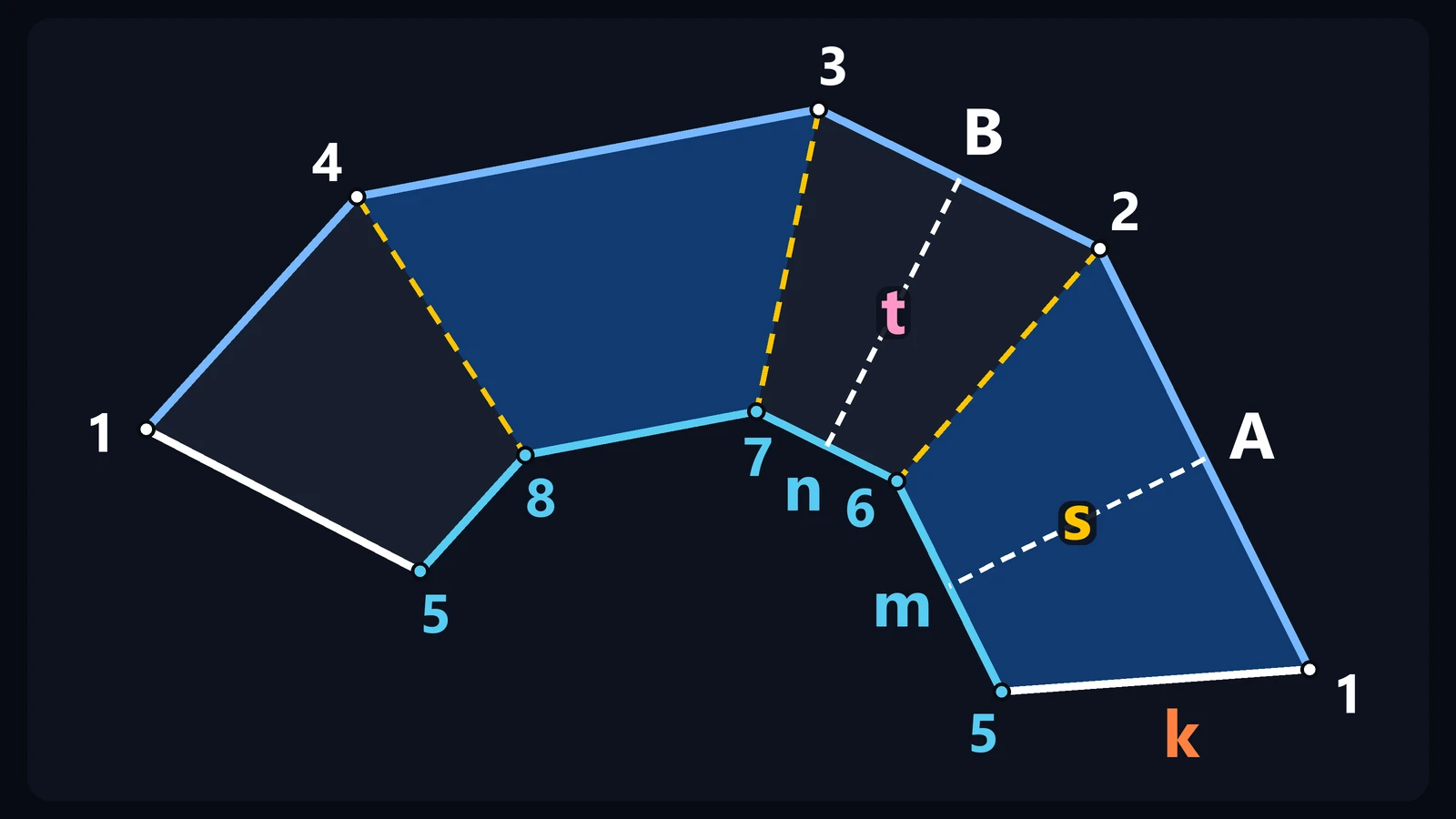
Figure 3: The pattern of the example, drawn to the same scale in both directions and rotated to fit better. The four trapezoids (A, B, A, B) are in a chain: the bases lie on the outer border (corners 1 to 4 and 1 again), the tops on the inner one (5 to 8 and 5 again), and the connecting edges are the dashed fold lines. The two free edges 1–5 (in white) are joined at the seam. Marked are the bases and the height of the face on side A (A, m and s), those of the face on side B (B, n and t) and the edge k.
Step 7 — Check, add the seam allowance and cut
The connecting edges (2–6, 3–7 and 4–8) and the two free ones (1–5) measure k = 393.70 mm, the bases measure 600, 400, 600 and 400 mm, and the area of the drawing matches the one in the table below. Add to the free edge the seam allowance the joint type calls for, leave the connecting edges as fold lines (or weld joints) and cut. You can also cut the four faces separately (A, m and s, or B, n and t) and weld them along the edges; in that case the chain in steps 5 and 6 is not needed.
Measurement table for the frustum of a pyramid pattern: 600 × 400 mm
Values for A = 600 mm, B = 400 mm, m = 300 mm, n = 200 mm and H = 350 mm. The two inclined edges of each trapezoid measure k = 393.70 mm. The area of each face is (large base + small base) ÷ 2 × height.
Face | Points | Bases (mm) | Height (mm) | Diagonal (mm) | Area (mm²) |
|---|---|---|---|---|---|
On side A (2 faces) | 1-2-6-5 and 3-4-8-7 | 600 and 300 | 364.01 (s) | 578.79 (p) | 163,802.47 each |
On side B (2 faces) | 2-3-7-6 and 4-1-5-8 | 400 and 200 | 380.79 (t) | 484.77 (q) | 114,236.60 each |
Total, 4 faces | 556,078.14 |
The total lateral surface adds up to 2 × 163,802.47 + 2 × 114,236.60 = 556,078.14 mm², or about 0.56 m² of sheet, not counting the seam or cutting losses.
Check from the apex (radial-line method)
Because the bases are similar, the edges meet at a point, the apex of the complete pyramid. The lateral edge of the complete pyramid is E = k ÷ (1 − m ÷ A) = 393.70 ÷ 0.5 = 787.40 mm. At the apex, the faces on sides A span an angle α, with sin(α ÷ 2) = 300 ÷ 787.40 = 0.3810, that is, α = 44.79°; the faces on sides B span an angle β, with sin(β ÷ 2) = 200 ÷ 787.40 = 0.2540, that is, β = 29.43°. The four angles add up to 2 × (44.79 + 29.43) = 148.44°, well under 360°: the pattern opens like a fan.
If the complete pyramid fits on the bench, the fan lays the piece out directly: with a rod that has a fixed point and a marking point (or a compass with a telescopic bar), draw an arc of radius E = 787.40 mm, step off the chords A, B, A and B (600, 400, 600 and 400 mm) along it, join the points to the center and mark the corners of the small base with an arc of radius E − k = 787.40 − 393.70 = 393.70 mm. If the apex is too far away, use the trapezoids.
Thin sheet folded or thick plate welded
The pattern above is geometric and ignores thickness. Use the same reference for all the measurements (all outside, all inside or all at the neutral axis) and adjust at assembly the bend radius, in thin folded sheet, or the bevel and gap, in thick welded plate.
Common mistakes in a frustum of a pyramid pattern
1. Using the height H as the height of the face
With H = 350 mm in place of s, the face on side A comes out 14.01 mm too low (364.01 − 350 = 14.01 mm). With t, the difference is 30.79 mm.
2. Taking the edge from the front view
The front view shows only u and H, and the edge appears with a length of √(122,500 + 22,500) = 380.79 mm. The true edge measures 393.70 mm: 393.70 − 380.79 = 12.91 mm more.
3. Swapping s and t
The face with bases A and m uses the inset v, which is the one in the other direction; the face with bases B and n uses u. When u ≠ v, swapping the two lengthens one face and shortens the other.
Frequently asked questions
What is a frustum of a pyramid and how do you develop it?
It is what is left of a pyramid when its tip is cut off by a plane parallel to the base. Its lateral faces are trapezoids, and developing them is laying out the frustum: calculate the height of the faces and the lateral edge, draw the trapezoids and join them along the edges.
How do you calculate the height of a hopper face and the lateral edge?
With s = √(H² + v²) for the faces on sides A, t = √(H² + u²) for the faces on sides B and k = √(H² + u² + v²) for the lateral edge, where u and v are the insets of the small base. In the example, s = 364.01 mm, t = 380.79 mm and k = 393.70 mm; all four lateral edges are equal.
How much sheet does a hopper need?
The lateral area is the sum of the four faces: (A + m) × s + (B + n) × t, which gives 556,078.14 mm² in the example, about 0.56 m². Add the seam and the cutting losses.
What if the base is square?
It is the simplest case: with A = B and m = n, the insets are equal (u = v), the four faces are equal and s = t. With A = B = 400 mm, m = n = 200 mm and H = 300 mm, u = v = 100 mm, s = t = √(90,000 + 10,000) = √100,000 = 316.23 mm and k = √(100,000 + 10,000) = √110,000 = 331.66 mm.
What if the small base does not have the same proportions as the large one?
If m ÷ A is different from n ÷ B, the lateral edges do not meet at a point, and the piece is no longer a frustum of a pyramid. If the small base is still parallel and centered, the four faces are still isosceles trapezoids and the formulas for s, t and k hold just the same; there is only no apex for the radial-line check.
See also
Step-by-step summary
To lay out the pattern of a rectangular frustum of a pyramid:
draw the top and front views and number the corners 1 to 8;
calculate the insets u = (A − m) ÷ 2 and v = (B − n) ÷ 2;
find the true lengths: s = √(H² + v²), t = √(H² + u²) and k = √(H² + u² + v²);
lay out the trapezoid on side A (bases A and m, height s) and check the edges (k);
add the trapezoid on side B (bases B and n, height t), positioned with the diagonal q;
complete the four faces in a chain and leave the seam on the free edge 1–5;
check the measurements and the area, add the seam allowance, mark the folds and cut.
Important
This article specifically covers the case of a right frustum of a pyramid with a rectangular or square large base and a small base that is parallel, centered and in the same proportions. Changing any of these conditions changes the pattern. When cutting the sheet, wear suitable personal protective equipment and clamp the piece securely.
Carry TraceClub in your pocket
Boilermaking layouts, calculations and technical manuals in the palm of your hand — fast, accurate and always with you in the shop or in the field.
- Available for iOS and Android
- Works offline
- PT · EN · ES